Which purchase route fits the equipment you already have?
Begin with the route from prepared water and empty bottles to the finished pack. Mark what is available, what needs replacement and what has not yet been selected. A wider package can reduce the number of separately managed equipment purchases, but its coordination and acceptance responsibilities still need to be written down.
| Route | When to evaluate it | Important quotation boundary |
|---|---|---|
| Stand-alone rinse-fill-cap machine | Existing water supply, bottle feed and downstream packaging are retained | Format parts, transfer, control signals and modifications to existing machines |
| Filling-to-packing package | Empty bottles are purchased and several filling/packaging stages are needed | Bottle feed, filling, labeling, coding, conveyors and selected final pack |
| Package with PET bottle making | On-site blowing from preforms is part of the project | Blower, molds, air/cooling equipment and transfer into the filling section |
Buying one machine still creates interface work
A replacement filler does not become compatible with an existing line merely because its quoted speed matches. Send the supplier bottle/cap samples, layout, conveyor height and direction, connection points, utility conditions and the available information about upstream and downstream equipment.
| Interface | Question to close | Record |
|---|---|---|
| Bottle transfer | Who adapts guides, transfer sections and bottle handling? | Approved interface drawing and parts list |
| Control handoff | Who confirms start/stop, accumulation and fault interactions? | Agreed signal list and responsible integrator |
| Utilities | Who supplies each auxiliary and connects at the machine boundary? | Utility schedule with connection conditions |
| Testing | What is verified before shipment and what requires the existing site equipment? | Separate agreed FAT and site-test responsibilities |
Example: bought-in bottles do not imply a blow molder
Illustrative project: the buyer purchases empty PET bottles and wants to automate filling and final packing. The first scope can cover bottle feeding, rinse-fill-cap, labeling, coding, conveying and the chosen pack format. On-site bottle making is a separate alternative, not an automatic inclusion.
If the buyer later considers blowing bottles from preforms, request a revised package that identifies molds, air and cooling needs, bottle-transfer arrangements and additional responsibilities. Do not compare the original filling-only price with the expanded package as though both deliver the same scope.
Separate equipment supply from factory readiness
A machine package does not automatically include a building, laboratory, incoming utilities, water-source approval or all local installation work. This page defines the equipment purchase boundary, not a complete factory design. Identify the buyer's site work and local engineering responsibilities separately.
Ask whether one party will only supply several machines, coordinate communication between manufacturers, or also take responsibility for defined interfaces and tests. These roles are different. The quotation should identify the contracted role and the evidence delivered for each obligation, rather than relying on the word ‘turnkey’.
Take the route decision into your RFQ
List existing assets by function and attach the drawings or photographs that help establish the handoff. Ask suppliers to mark required equipment included, optional, buyer supplied, excluded or open. For alternatives, request separate schedules so the proposed machine and the broader package can be compared without losing their different boundaries.
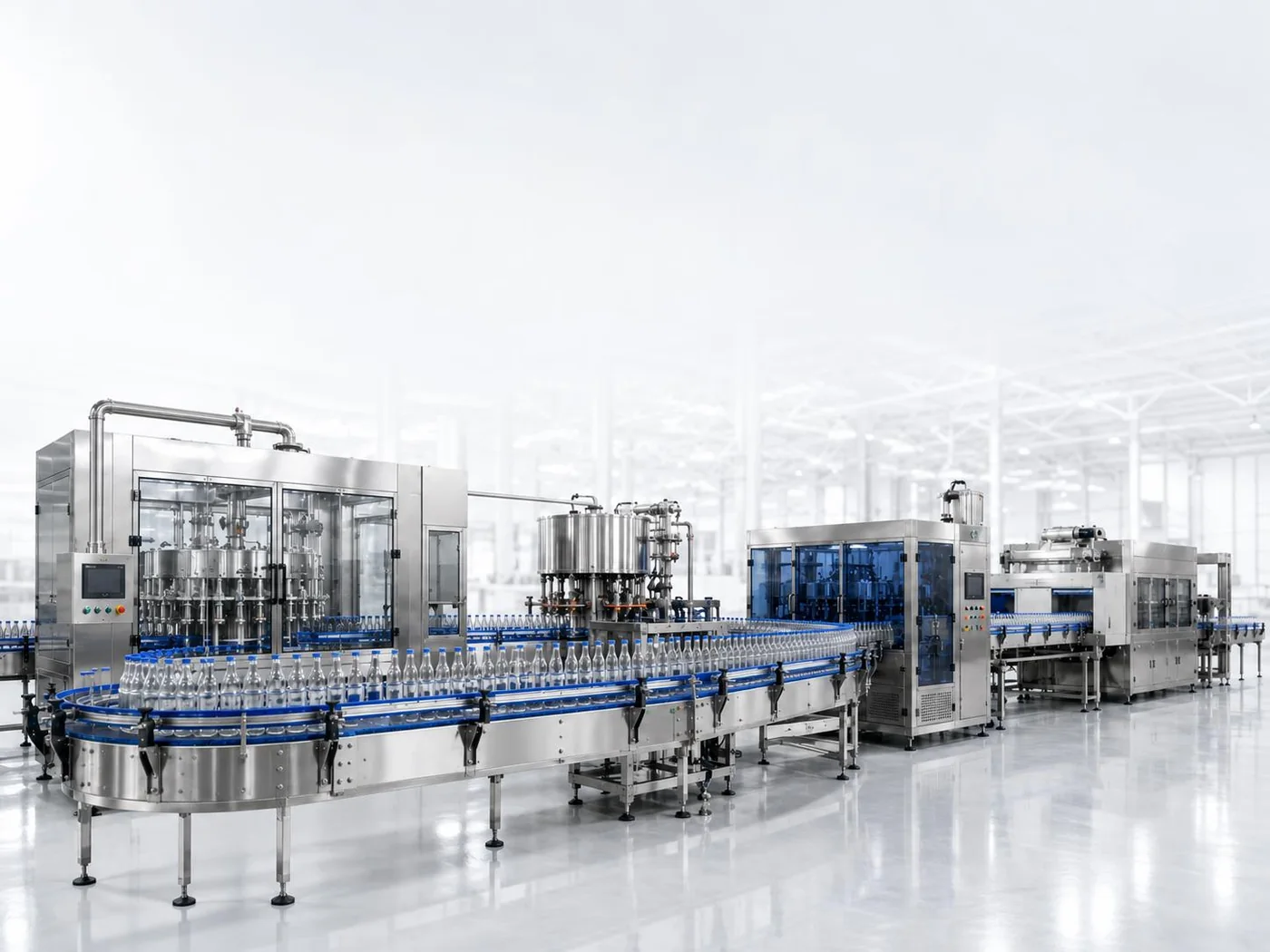
Catalog equipment reference
See the equipment before defining the final specification.
This image supports machine-category identification. Final model, output, materials, dimensions, utilities and included accessories still require a confirmed project quotation.
Source: Allot Tech Beverage Bottling Catalog 2026, page 1.
Questions to close before purchase
Can I buy only a filling machine if I already have treatment and packing?
Yes, a stand-alone purchase can be evaluated, but the water supply, bottle/cap fit, transfer, controls and packaging interfaces need confirmation. Record who supplies modifications and which tests require the existing equipment.
Does a complete equipment package include factory construction?
Not automatically. Equipment, auxiliaries, services and buyer-side site work must be listed explicitly. A package quotation is not evidence that building work or every factory utility is included.
Is one supplier responsible for all integration?
Only for the responsibilities it explicitly accepts. Confirm the contracting party, equipment sources, mechanical/control interface owners and acceptance obligations. Supplying multiple machines is not the same as accepting every integration task.
What you should leave with
- A purchase route tied to existing equipment
- A list of missing functions
- Named interface responsibilities
- An explicit quotation boundary
Continue the buyer decision workflow
Water Bottling Machines: Equipment Types and Supply Scope
Choose water bottling equipment for bought-in bottles, on-site PET blowing or an upgrade. Compare treatment, filling, labeling and packing supply scope.
Water Bottling Machines: Equipment Types and Supply ScopeWater Bottling Machine RFQ: Inputs and Copyable Brief
Prepare a water bottling machine RFQ with bottle, cap, output, equipment scope and site inputs. Use a format checklist and copyable supplier email.
Water Bottling Machine RFQ: Inputs and Copyable BriefWater Bottling Machine Quotation: What to Include
Check a water bottling machine quotation for equipment, output basis, format parts, utilities, tests, documents and service. Use a clarification template.
Water Bottling Machine Quotation: What to IncludeWater Bottling Equipment Scope Builder
Build a water bottling equipment scope brief. Select requested modules, identify bought-in bottles or returnables, and list open supplier responsibilities.
Water Bottling Equipment Scope BuilderLast reviewed: 2026-09-17. Technical values and equipment availability are project-specific unless explicitly identified as catalog-reference information.