Do you need a new water-treatment system?
Not necessarily. A new bottling project may require treatment, while a filler replacement may use an existing prepared-water system. Tell the supplier what already exists, where its performance is documented and what connection the proposed filling machine needs. Existing equipment is not automatically suitable, but it is not automatically a new purchase either.
Use a current, traceable source-water report and a written target for the finished water. Identify the sampling point, date, source and any known variation; let the treatment reviewer identify missing tests. A product description such as purified water or mineral water is not a complete treatment specification. The applicable product requirements need separate confirmation by the responsible project specialists.
RO, filtration and disinfection are separate decisions
Reverse osmosis is one possible treatment step, not a compulsory accessory to every water filler. The proposed process must relate to the source-water analysis and the intended finished-water composition. Ask why each stage is included and which quality target it addresses; do not assume that adding more stages necessarily improves the intended product.
Where filtration, membrane treatment, disinfection, storage or recirculation is proposed, request the process description and its verification basis. This page helps define the supplier's scope; it does not prescribe a treatment train, certify drinking-water safety or approve a product claim. A catalog image of an RO skid does not establish suitability for your source.
Read treatment capacity on the correct water-flow basis
Distinguish incoming feed flow, usable product-water flow and any reject, backwash, cleaning or other demand. Ask where each stated flow is measured and under which feed conditions. A quotation stating only a capacity number without units and measurement boundary is not ready for comparison.
Illustrative product-volume check only: 6,000 bottles per hour × 0.5 liter per bottle = 3,000 liters per hour, or 3 m³/h of water inside the bottles. This excludes rinsing, cleaning, process losses, downtime and other uses. It is neither an Allot Tech equipment rating nor a recommendation to buy a 3 m³/h treatment skid.
If daily production is used instead, state the hours actually available for filling and the operating schedule of treatment and storage. The supplier must assess the remaining demands, recovery assumptions and storage interaction. Do not add an unexplained percentage and present it as an engineered design.
Separate the treatment package from site connections
| Boundary | Evidence to request | Scope question |
|---|---|---|
| Source to treatment inlet | Source report and proposed inlet conditions | Who supplies feed storage, pumps and piping where required? |
| Treatment stages | Process description, equipment schedule and performance basis | Which stages, instruments and consumables are included or optional? |
| Treated-water storage and transfer | Tank/transfer scope and connection drawing | Where does the package end and who connects it to filling? |
| Cleaning and reject streams | Proposed cleaning method and discharge requirements | Who supplies the applicable equipment, connections and site handling? |
| Controls, records and verification | Control-interface list, manuals and agreed test plan | Who confirms the feed basis, output criteria and handoff records? |
What must a comparable supplier response contain?
Ask the supplier to link its process choice and stated product-water flow to the supplied analysis and target. Separate confirmed requirements from assumptions that remain open. Identify the proposed model, included instruments, initial consumables, replacement-item information, utilities, exclusions and work assigned to others.
Agree how the proposed performance will be verified with appropriate water and operating conditions. Where actual source water cannot be represented in a factory test, record the limitation and the remaining site-verification responsibility. A factory demonstration with different feed water is not proof that the installed system meets your final water specification.
Send this treatment scope brief with your enquiry
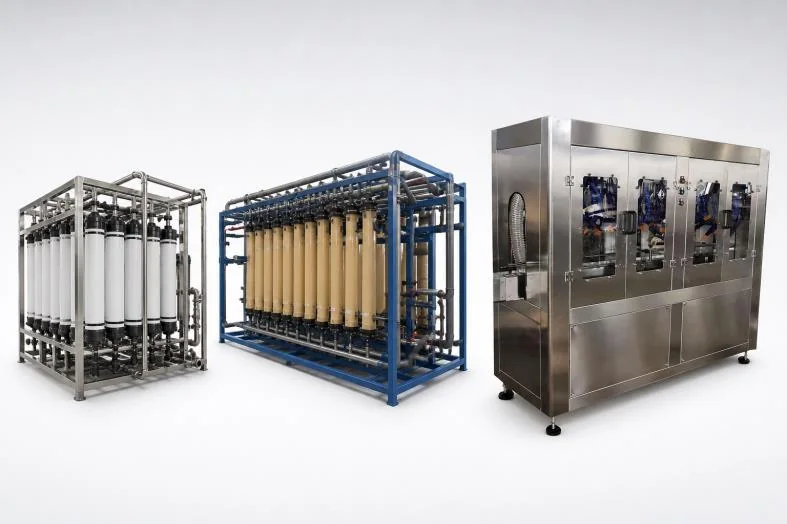
Catalog equipment reference
See the equipment before defining the final specification.
This image supports machine-category identification. Final model, output, materials, dimensions, utilities and included accessories still require a confirmed project quotation.
Source: Allot Tech Beverage Bottling Catalog 2026, page 29.
Questions to close before purchase
Does every water bottling machine need reverse osmosis?
No universal treatment choice follows from buying a filler. The source-water evidence, intended finished water and applicable project requirements must determine the proposed process, with responsible technical review.
Is 3 m³/h treatment enough for 6,000 bottles per hour at 500 ml?
That filling rate contains 3 m³/h inside the bottles, but the arithmetic excludes other demands and process losses. The treatment and storage requirement needs supplier assessment on the actual feed, operating schedule and supply boundary.
Are treated-water tanks and piping included?
Only when the offer identifies them. Request the treatment outlet, storage, transfer, filler connection and control handoff as separate included, optional, retained or buyer-supplied items.
What if the water analysis is not ready?
Mark it pending and ask which information is needed. Any preliminary process or price should state its assumptions and required review; do not treat it as a final treatment selection.
What you should leave with
- A source/target-water brief with unresolved information visible.
- A product-water demand basis separated from treatment feed and losses.
- An itemized treatment-to-filler boundary with named supplying parties.
Continue the buyer decision workflow
Water Bottling Machine RFQ: Inputs and Copyable Brief
Prepare a water bottling machine RFQ with bottle, cap, output, equipment scope and site inputs. Use a format checklist and copyable supplier email.
Water Bottling Machine RFQ: Inputs and Copyable BriefWater Bottling Machine Quotation: What to Include
Check a water bottling machine quotation for equipment, output basis, format parts, utilities, tests, documents and service. Use a clarification template.
Water Bottling Machine Quotation: What to IncludeWater Bottling Equipment Supplier Responsibility Matrix
Define buyer and supplier duties for water bottling equipment: supply, interfaces, utilities, documents, FAT and site handoff with a responsibility worksheet.
Water Bottling Equipment Supplier Responsibility MatrixWater Bottling Machine RFQ Builder & Quotation Brief
Prepare a copyable water bottling machine RFQ with bottle, cap, output, label, pack, utilities and equipment scope. Keep missing facts clear before requesting quotes.
Water Bottling Machine RFQ Builder & Quotation BriefLast reviewed: 2026-09-28. Technical values and equipment availability are project-specific unless explicitly identified as catalog-reference information.